Digital channels have become the standard in B2B sales. Customers are adapting faster than many companies — and the result is clear: businesses that fail to evolve are already losing opportunities.
A portal that offers only a product list and a basic checkout no longer meets market expectations.
Modern buyers demand continuous availability, fast and accurate information, personalized pricing, visibility over their orders, and control over their purchasing processes.
Below are six essential capabilities that define a competitive B2B portal in 2026.
1. Customer-Specific Pricing in Real Time

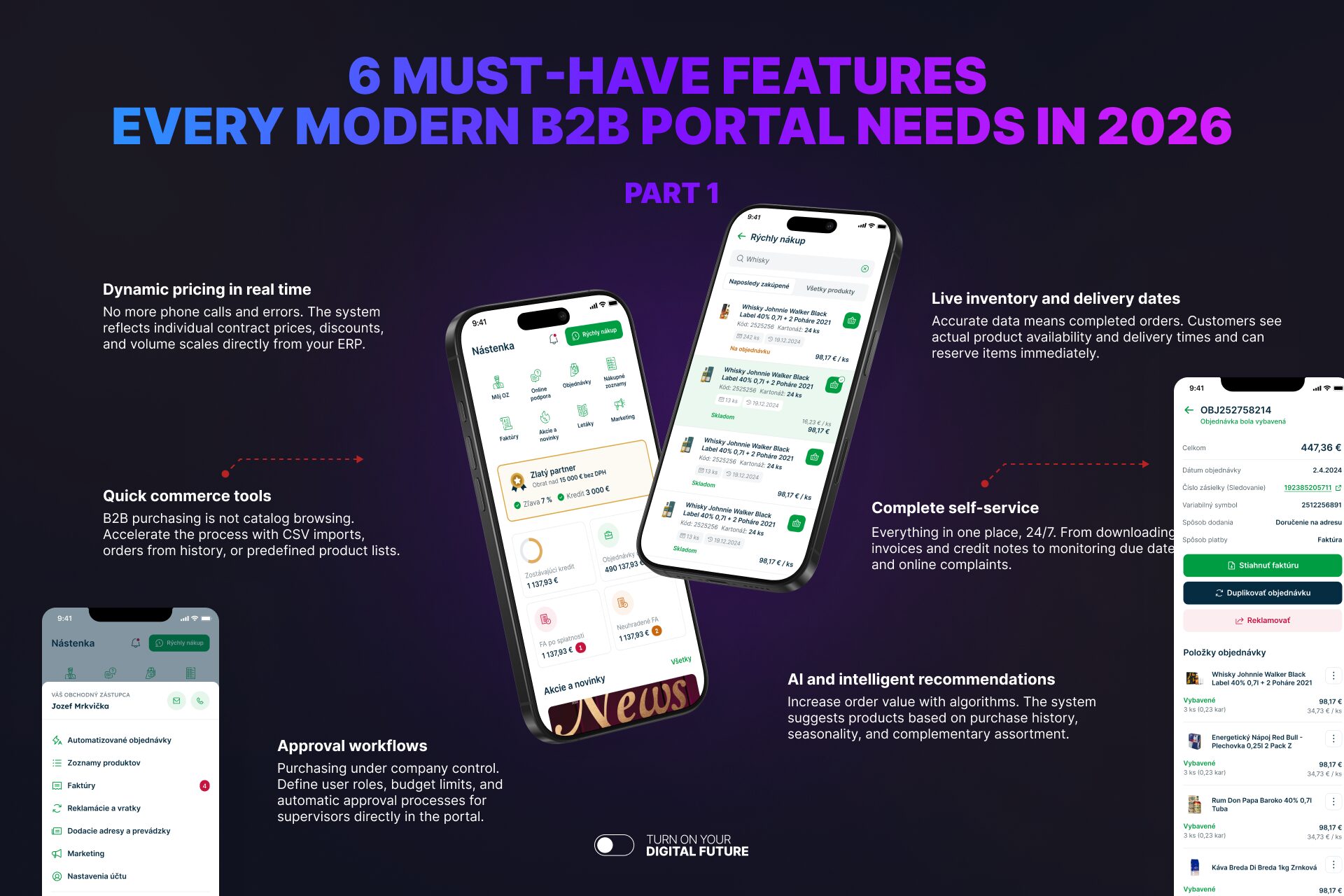
Unlike B2C, pricing in B2B is highly individual. Each customer has unique agreements, discounts, and pricing tiers. A strong portal therefore needs to:
present tailored pricing for each customer,
synchronize immediately with ERP changes,
calculate bulk discounts automatically.
Without this, companies quickly face confusion, unnecessary emails, and manual corrections.
2. Real-Time Inventory Transparency
Before placing an order, customers need certainty: is the product available, how much stock remains, and when will it arrive? Modern B2B portals solve this by offering:
up-to-date stock visibility,
the ability to reserve products,
reliable delivery estimates.
Clear information directly increases completed purchases.
3. Repetitive Ordering and Purchase Acceleration

In many B2B businesses, the majority of orders consist of recurring products.
That is why customers value:
This transforms the portal into an operational tool rather than a simple webshop.
4. AI-Based Product Recommendations
B2B buyers now expect smart suggestions similar to consumer platforms. With modern AI, recommendations can be based on:
The impact? Higher basket values and stronger customer relationships.
If you are interested in measurable outcomes and return on investment, you can explore this further in our article How Fast Can a B2B Portal Deliver ROI.
5. Digital Approval Flows and Purchasing Control

Purchasing in companies is rarely handled by a single person. Orders often need to follow internal rules, budget limits, and approval hierarchies.
A modern B2B portal therefore supports:
spending thresholds – larger orders are automatically routed for approval,
structured approval flows – requests reach the right decision-maker without manual intervention,
user roles and access rights – ensuring everyone sees only relevant prices, products, and reports.
6. A Centralized Customer Workspace

Business customers expect full transparency and self-service. Their account should include:
invoices
credit notes
order history
complaints and claims
payment schedules
Without this level of access, a portal quickly loses its competitiveness.

Why Strategy Matters More Than Features
Today’s B2B buyers are not simply looking for a digital catalog.
As discussed in our article The B2B Zone as a Strategic Growth Channel, they expect a connected digital environment that reduces manual effort, speeds up operations, and delivers reliable data without delays.
This is where a clear digital roadmap becomes critical.
Every organization has different systems, processes, and limitations. Understanding where to start, what delivers the highest impact, and which improvements truly matter is the foundation of successful digital transformation.
We support companies throughout this journey. Digitalization does not have to be complicated — it simply requires the right direction. And that is where we can help.